Everything wired to everything else
Wow.
Talk by Vilayanur Ramachandran in 2007´s TED conference.
Today someone gave us a presentation on his product. Things I remember in no particular order:
1. Seven bullet points in a single slide, all appearing at the same time...as an introduction.
2. Misspellings in several pages.
3. ¨Yes, I´ll answer that but first let me show you this other feature because if not we´ll be here ´til tomorrow morning¨. (yes, he did say that).
4. He spoke for 20 minutes more than we had agreed.
The message I got was:
¨I´m here to tell you about my product. I know you have problems, and I don´t know them yet. If we have time at the end, we´ll discuss your situation; but first, let me tell you all about the features of my product and the things it can do. I hope this will impress you enough to ask me to come again, and then prepare a proposal.¨You have an option: try to sell features, or offer to solve problems (that those features happen to solve). The problem with the first approach is that people can tell it´s not ALIGNED with their needs.
2,000 visits and counting! Thanks for stopping by, seriously. Attention is a gift, so I appreciate your reading this.
Be gud. Live laif. ;-)
3pm, exhausting day @ work, your mind starts spinning...You come up with a suspiciously funny joke:
¨How do they mute a phone in [insert favorite place here]?¨
Will you marry your idea of me!????
Update: Craig Harper says it better. Read his post the morning after posting mine. Talk about coincidence. Worth reading ;-)
So it turns out that trying to get something from someone is really not a selfish act. At least not if you want to be successful.
Dale Carnegie wrote ¨How to win friends and influence people¨. A central idea to the book is that there is only one way to make someone do something; and that is by making that person WANT to do it.
So the next question is: how to MAKE someone WANT to do something?
Enter Charles Green, author of ¨The Trusted Advisor¨ blog. ¨In order to get someone to buy from you something she needs, first you need to understand what it is that she wants (in life).¨
Is what you´re asking for ALIGNED with the other person´s values and desires?
Por aquello de que me encantan las analogías...
Esta imagen me pareció la analogía perfecta para mi estado de ánimo cuando la tomé. Llevaba así un par de meses: cuesta arriba, sabiendo que iba a algún lado pero sin entender muy bien dónde ni si quería.
Desde esta semana es más algo como así:
Amplitud, serenidad, empezando a percibir la luz que se asoma.
Qué foto define tu estado de ánimo?
This makes me wonder what the future of education as we understand it will be like:
www.freebase.com Via techcrunch: "Freebase is a massive database. The purpose of the database is to centralize as much data as possible, and allow participants to freely add and access data - developers can extract information from Freebase via a set of APIs and add it to their web applications. It also builds relationships between highly structured pieces of data, something that can’t easily be done with distributed data controlled by different entities. "
Pensamiento cínico del día:
“Lo de que el cambio frecuente de trabajo se ve mal en el curriculum se lo han inventao las empresas mediocres, hombre! Para que no se les vaya la peña en cuanto descubren lo mediocres que son.”
Ja!
Firmado: yo.
Tenía curiosidad por saber cuánto cuesta un seguro médico individual, así que hoy llamé al número del primer seguro que vi.
Como de costumbre, una máquina te recibe. La opción pre-programada para atender llamadas de potenciales clientes nuevos se llama (y lo digo porque entenderlo no fue inmediato): ¨Ventas Nuevas¨. Esto es una sutileza, pero demuestra en quién estaba pensando el que programó el cuadro telefónico. Peor aún, hace pensar que la programación la aprobó cualquier ¨comité¨ formado ad hoc a tal efecto.¨No me importa quién llame, para NOSOTROS esto es una venta nueva.¨ o ¨Hola, me estoy dirigiendo a tí en mi idioma...y quiero que me compres.¨
El problema con declararse ¨orientado al cliente¨ es que hay que alinear cada operación del día a día con ello. Y programar los sistemas de ATENCIÓN AL CLIENTE basados en tecnicismos internos, no lo está.
PD. Nunca cogieron el teléfono. Esa es otra...
Words of wisdom for the day, by Seth Godin: “More is easy to sell. Less almost never is”.
Yesterday I was thinking about the “positive-action oriented” rather than “negative-action deterrent” ways of saying things or giving feedback. “Don’t do this” versus “do more of (the opposite)” .
If we are to achieve our goals, and we want to align everyday actions with the long-term vision, I suggest we approach things from a standpoint of DOING rather than NOT DOING. The latter leads to inaction, that leads to fear of failure. And fear of failure is Evolution's bottleneck.
What do we do when a process doesn’t work in a Company?
We re-engineer it. After all, “process re-engineering” is to problems what aspirin is to headache: let’s shift some responsibilities, move some people around, arrange more meetings. And then, management’s selling line: “We are sure that OUR PEOPLE will understand this and execute accordingly”.
What have we done? We (think we have) have aligned “what we (must) do” (must is key here) with what we want to achieve.
The problem is that we seldom pay attention to the HOW and the WHY.
How people should execute processes is more important than the processes themselves, because it gives you the ability to improve them naturally. The correct HOW is achieved when people understand WHY. In other words, to achieve your long-term objectives, you need to make sure people understand why they do what they do everyday and how their activities contribute to achieving those goals. Because not always people understand WHY they must do what they are doing.
In your company, what percentage of people would you say can connect what they do everyday to the business strategies?
This from the website www.plantingpeace.org
Did You Know...
Makes you think...30,000 people die everyday from starvation
150 million street children world wide
842 million people across the world are hungry
798 million people in the developing world are undernourished
Half the world -- nearly three billion people -- live on less than 2 dollars a day.The developing world now spends $13 on debt repayment for every $1 it receives in grants.
To satisfy all the world's sanitation and food requirements would cost only $13 billion, hardly as much as the people of the United States and the European Union spend each year on perfume.
Urging humans to make a conscious personal effort in there daily life’s to bring betterment to the planet so every creature grandchildren's grandchildren can simply live.He´s built orphanages and homes for kids and adults in Ecuador, Haiti and Guatemala; more projects underway.
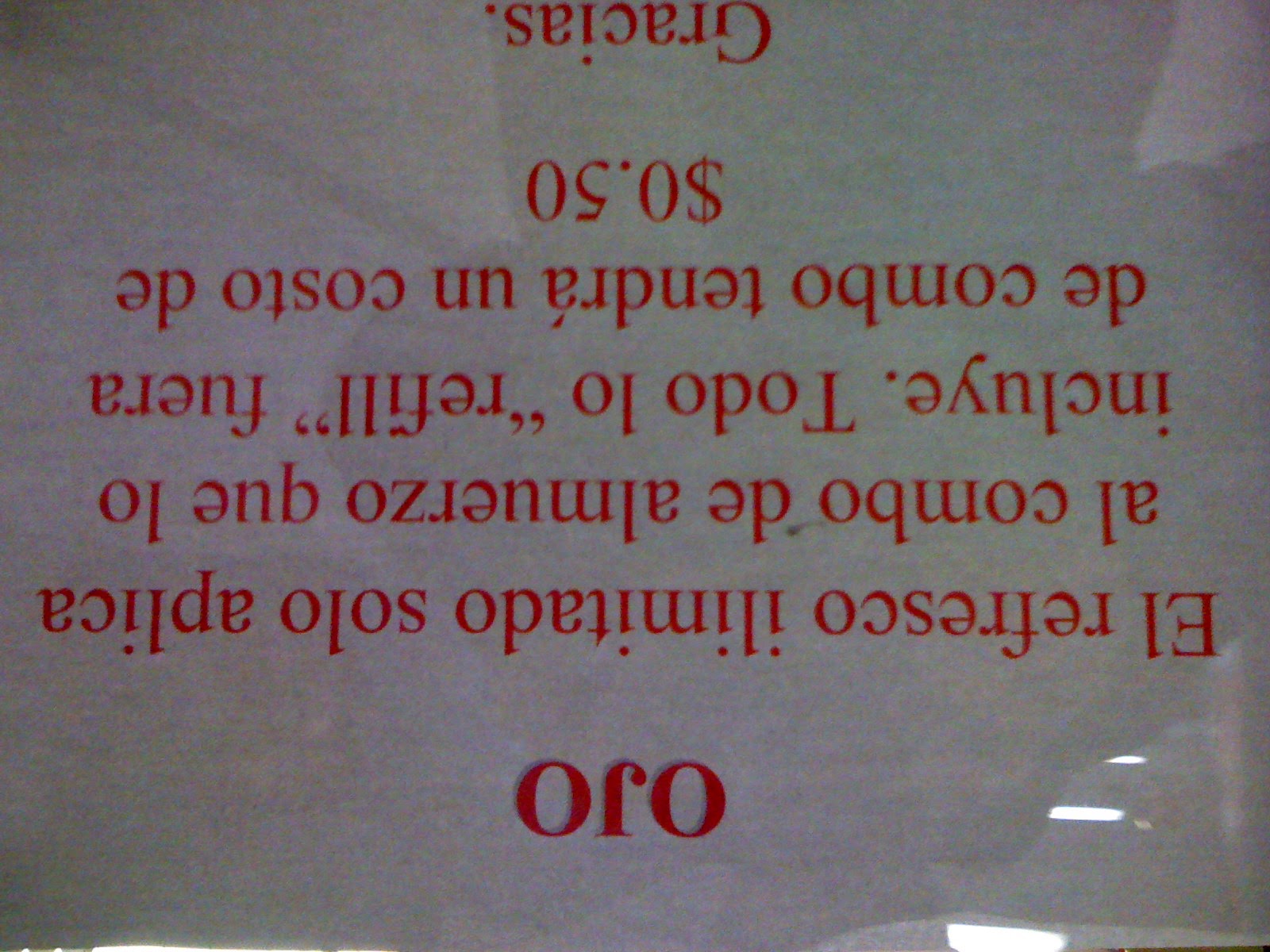
Así se te queda el cuerpo antes de entrar a la cafetería de mi oficina. No porque el cartelito está al revés (lo que pasa es que no consigo darle la vuelta), sino por lo del OJO.
El cartel cumple uno de los dos objetivos por los que está ahí: captar la atención. El segundo (que la gente haga caso) no se cumple, por culpa del primero.
Por qué? Si has tenido que poner ese cartel en la puerta, cuando hace meses que las instrucciones están visibles en otros sitios es porque quieres advertir claramente que estás pendiente de ello. Te estás dirigiendo a los que no te hacen caso, simplemente estás gritando más alto.
Interpretación del cliente que no ¨roba¨ (que es la inmensa mayoría): les importa más reducir una ¨pérdida¨ de, digamos, 25 centavos por 100 personas que lo hagan al día (que lo van a seguir haciendo, las instrucciones ya estaban), a asegurarse de que, por ejemplo, la cajera te hable (no digo ya sonría) para que tu experiencia en el lugar sea buena y vuelvas mañana.
Si tu estrategia a largo plazo es alta satisfacción de clientes, deberías asegurar que la interacción de estos en el día a día está alineada con ello. Y un mensaje de bienvenida (no una advertencia) ayuda. Mucho.
¨Traducción¨:
* Combo = menú
* Refill = relleno
Ah, yo bebo agua, no Coca-Cola ;-)
Ok, I´m back. ¨Stop and smell the flowers¨ kind of lapsus.
Alguien muy sabio me dice por ahí que al blog le hace falta vidilla en español, así que como estoy de acuerdo...bienvenidos al primer blog bilingüe que conozco ;-)